With rising challenges in the supply chain and the expansion of
e-commerce, the development of technologies and their implementation in
logistics market is highly anticipated. Can the warehouse communicate directly with inventory or simply pick the items? It may sound like the storage of the future, but the technology is already here and enables something called Smart warehousing.
What is Smart Warehousing?
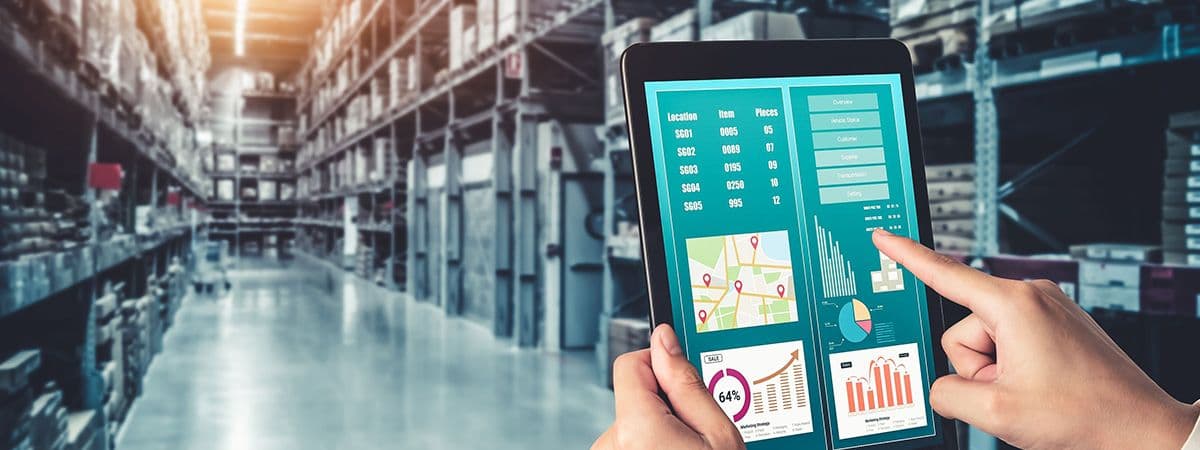
Inspired by smart factories, smart and technologically driven warehouses are now emerging. The goal of these systems is to provide companies the information about the supply of available raw materials, spare parts or finished goods in the real time.
Smart warehouses incorporate various automated and interconnected information systems to create an environment where goods can be automatically recognized, received, sorted, organized and prepared for distribution. Unlike traditional
warehouses, smart warehouses use the latest technology to streamline all internal processes.
Benefits of Smart Warehousing
Smart warehouse requires an investment of time and money, and for most companies such an investment pays off.
Warehouse management usually faces complex and contradictory requirements - the constant need to reduce costs, while simultaneously increasing flexibility, reliability and efficiency. Today it is easy to reconcile them and enable to work in the best interest of companies, as they rely heavily on the Internet, robotics and artificial intelligence.
The basis of a smart warehouse is a
Warehouse Management System (WMS). It can be set up locally as a software solution or as a Cloud service - a special type of network where data is stored and can be accessed outside the office from any authorized device - mobile phone, tablet, laptop. The systems monitor daily warehouse operations and reveal process efficiencies as well as the areas for improvement.
The use of WMS can also have a positive effect on other important processes such as:
Optimizing the layout of the warehouse
Reduction of overhead costs
Access to quality data in real time
Simplified storage processes and less paperwork
Improved accuracy (fewer errors)
Better safety and lower number of injuries
Better relations with suppliers and customers
Smart warehouses also use robots, which are often similar to
Roombas - robotic vacuum cleaners. The process of picking up the products is automated with their use, as robots physically deliver the requested items to employees, who then pack the orders for further distribution.
In order for robots to be able to communicate with other technologies in the smart warehouse, another component is needed:
IoT (The Internet of Things) - a network of "things" in which sensors, software and other technologies are embedded for the purpose of exchanging data with other devices and systems over the Internet. In warehouses, IoT consists of connected sensors to vital machines or assets over the Internet, making it possible to control all moving parts in the warehouse.
Artificial intelligence (AI) is the ability of a machine to gather knowledge from experiences and act on those experiences, and is mostly used to increase productivity and minimize errors. Robots can use artificial intelligence to find the most efficient way to identify and select products.
RFID (Radio Frequency Identification) allows warehouses to switch from paper methods to tracking the items in the warehouse by using the digital tags. These are small, affordable tags that are attached to products or pallets. RFID uses technology that is based on radio waves to record and report the location of the item carrying the tag in real time. Also, this system is slowly taking the place of barcode readers. While barcodes had to be precisely aligned with a reader to be registered, RFID scanners can read up to 1,000 tags per second simultaneously and report to the Warehouse Management System.
Wearable Devices
Warehouse employees work in an environment that is subject to strict deadlines and is characterized by a fast pace of work. They are expected to perform their repetitive tasks efficiently. In order to be able to move quickly throughout the facility and continuously access important information, they often use various wearable devices that are an excellent solution for smart warehouse. Examples of wearable devices include smart glasses, headphones, as well as an innovation known as an exoskeleton - an electrically motorized device, worn like a vest, that reduces the pressure on the body when lifting loads of up to 30 kg.
Collaborative Robots
Collaborative robots "cobots" are fully autonomous robotic technologies that are intended to work with employees, not replace them. Warehouses that already use them tend to keep most of their existing infrastructure, but are able to optimize processes with cobots. Cobots do not require large investments, they can be used for material handling, such as picking, packing orders and inventory management.
The Future of Smart Warehousing
Smart warehouses and processes are slowly becoming the standard practice in today's business world. These facilities are equipped with advanced solutions that allow them to operate more efficiently and independently, marking a shift from slow, static and reactive supply chains. The distinction between warehouse and factory is predicted to disappear, as smart systems increasingly allow companies to produce the items on demand and immediately dispatch the finished goods to the customer.
By implementing smart
warehousing processes, companies will be able to simplify operations, reduce costs, increase efficiency, and thus improve the overall customer experience.